Published by Techeot Sanaatan Foundation.
Category: Culture & Heritage | Project T.I.B.E.T. | Technology Reading Time: 7 minutes
The first time our team sat down with scholars from Sarah College for Higher Tibetan Studies — the institution under the Central Tibetan Administration with which Techeot Sanaatan Foundation has formally partnered for Project T.I.B.E.T. — we came prepared. We had presentations. We had prototypes. We had a roadmap of digital tools, AI workflows, content pipelines, and distribution strategies.
The senior scholar listened patiently to all of it. Then he asked a single question.
"When you have made all of this content — who will it serve?"
We said: young Tibetans in the diaspora. Students who want to learn about their culture but cannot access it in traditional forms.
He nodded. Then he said something that has stayed with us ever since.
"Technology is very good at carrying a message. Make sure the message deserves to be carried."
The Danger of Technology Without Wisdom
In the excitement of digital transformation — of AI-generated content, virtual reality experiences, gamified learning — there is a real danger that we mistake the medium for the message. That we become so focused on how to deliver knowledge that we forget to ask whether what we are delivering is actually knowledge.
This danger is acute in cultural preservation work. The temptation is to digitise everything, publish everything, make everything accessible — and call that preservation. But a culture is not a database. It is a living transmission — from person to person, in context, with all the nuance, relationship, and lived experience that context provides.
A video of a sacred Tibetan ritual, stripped of its monastic context, its lineage history, and its practitioner's explanation of what it means, is not preservation. It is extraction. And extraction, however well-intentioned, can damage the very thing it claims to protect.
The Principle That Guides Project T.I.B.E.T.
From the beginning, Project T.I.B.E.T. has been built on a principle that sounds simple but has profound implications: technology serves culture; culture does not serve technology.
This means that every piece of content we produce — every audiobook, every video, every game, every animated film — is produced in consultation with Tibetan scholars, monastic authorities, and community representatives. Not as a rubber stamp. As genuine co-creation.
It means that when we produce audiobooks from the Bodhicaryavatara, we do not simply convert text to audio. We work with scholars to ensure that the narration is contextually accurate, that difficult concepts are explained appropriately, that nothing is simplified to the point of distortion.
It means that when we develop interactive 3D cultural learning games, the cultural content is designed by Tibetan cultural experts first — and the game mechanics are built around that content, not the other way around.
Technology in the service of wisdom. Not wisdom in the service of technology.
Why This Matters for Tibetan Culture Specifically
Tibetan Buddhism is not a set of beliefs. It is a practice tradition — transmitted through direct relationships between teachers and students, through oral commentary, through years of contemplative practice. The texts are not self-explanatory. They require a living teacher to make them intelligible and to prevent misunderstanding.
This creates a particular challenge for digital preservation. How do you digitise a transmission tradition? How do you make accessible what was designed to be transmitted only through specific relational contexts?
The answer is: carefully, incompletely, and in full acknowledgment of what cannot be transmitted digitally.
What can be digitised: the texts themselves, historical and cultural context, introductory explanations for general audiences, the lives and teachings of great masters in documentary form, language learning resources, cultural and artistic heritage.
What cannot be fully digitised: the actual practice transmission, the lineage relationship, the experience of living in a community of practitioners, the direct encounter with a realized teacher.
Project T.I.B.E.T. is explicit about this boundary. We create the outer layer — the accessible, introductory, contextualising content that invites a young Tibetan in Toronto or Delhi or London to want to know more. What they do with that invitation is between them, their tradition, and their teachers.
The Living Dharma Series: An Example of the Principle in Action
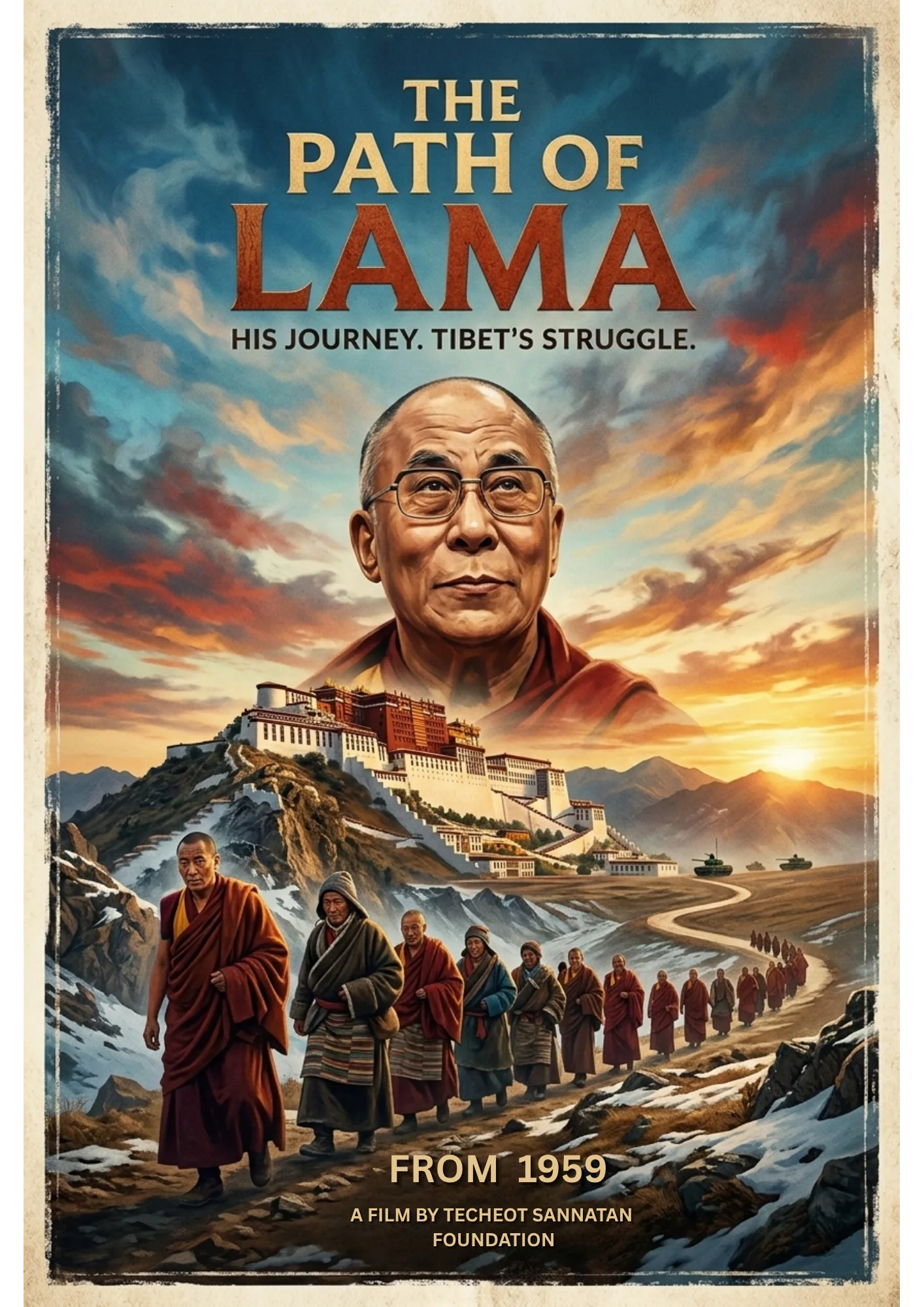
One of Project T.I.B.E.T.'s flagship outputs is the Living Dharma video series — short visual storytelling films based on teachings from the Bodhicaryavatara and other core Tibetan Buddhist texts, designed for younger audiences.
Each episode is developed in close consultation with Sarah College scholars. The philosophical content is reviewed for accuracy and appropriateness. The visual representations of sacred figures and ritual objects follow established iconographic conventions. The language is simplified without being distorted.
The result is not a substitute for traditional teaching. It is a door — beautifully crafted, respectfully positioned — that opens toward the tradition. The tradition itself is behind the door.
That is what the monk was asking us to be sure of. That behind our technology, there was something worth entering.
Project T.I.B.E.T. is TSF's flagship cultural preservation initiative in collaboration with Sarah College for Higher Tibetan Studies. Learn more at www.sanaatan.io