
Published by Techeot Sanaatan Foundation.
📂 Health & Medical Services | Rural Development ⏱ 7 min read
There is a simple and devastating truth about India's public health system that almost nobody says out loud: we are extraordinarily good at treating diseases, and extraordinarily bad at preventing them.
The result is a system that spends enormous amounts of money — government money, private money, donor money, insurance money — at the point of maximum expense: the large hospital, the complex surgery, the intensive care unit. Meanwhile, the relatively small investment that could have prevented the crisis in the first place is nowhere to be found.
The Numbers Tell the Story
India's out-of-pocket health expenditure is among the highest in the world — over 60% of total health spending comes directly from patients and their families. Medical expenses are the single largest cause of rural families falling below the poverty line.
Yet most of these catastrophic expenses are for conditions that are either preventable or — if caught early — cheaply treatable. Diabetes that wasn't detected until the complications set in. Cervical cancer that could have been caught by a ₹300 test but wasn't found until it required a ₹3 lakh treatment. Tuberculosis that spread because primary care was inaccessible.
"Every rupee spent on prevention saves between ₹5 and ₹15 in treatment costs. This is not speculation. It is documented health economics."
The Ayushman Bharat Paradox
The government's Ayushman Bharat scheme provides health insurance of up to ₹5 lakh per family per year for hospitalisation. It is a remarkable initiative — and a necessary one. But it is, by design, a treatment scheme. It covers hospitalisation. It does not cover the annual check-up that would have prevented the hospitalisation.
Consider this: if a government is willing to spend ₹5 lakh treating a family's illness after it has become severe, would it not be far more efficient to spend ₹15,000-20,000 per year on preventive health services for that same family? The mathematics are straightforward. The political economy is not — because prevention is invisible and treatment is photographable.
What Primary Preventive Health Actually Looks Like
The elements of basic preventive health are not complicated. An annual blood panel — checking blood sugar, haemoglobin, thyroid, kidney function, cholesterol. An eye examination that catches glaucoma or refractive errors before they affect a child's ability to learn or an adult's ability to work. A dental check-up that catches infections before they spread or teeth that are causing chronic pain. A chest X-ray or spirometry test that catches tuberculosis or chronic obstructive pulmonary disease in its early stages.
The total cost of this basic annual health check for one person, in a well-organised camp setting: approximately ₹800-1,500. For a family of five: ₹4,000-7,500. Per year.
Compare that to the cost of the crisis it prevents.
Ayurveda and the Wisdom of Prevention
What is remarkable is that Indian civilisation understood this principle 3,000 years ago. Ayurveda — the traditional Indian system of medicine — is, at its core, a preventive health system. The word 'Ayurveda' means 'the science of life' — and its primary emphasis is on maintaining health, not merely treating illness.
The concept of 'Swastha' in Ayurveda — literally 'established in the self' — describes the state of complete physical, mental, and spiritual balance that is the goal of Ayurvedic practice. The Ashtanga Hridayam, one of the foundational Ayurvedic texts, begins not with diseases but with daily and seasonal routines for maintaining health.
The wisdom was always there. The modern health system has simply not learned from it.
What a Community Preventive Health Model Could Look Like
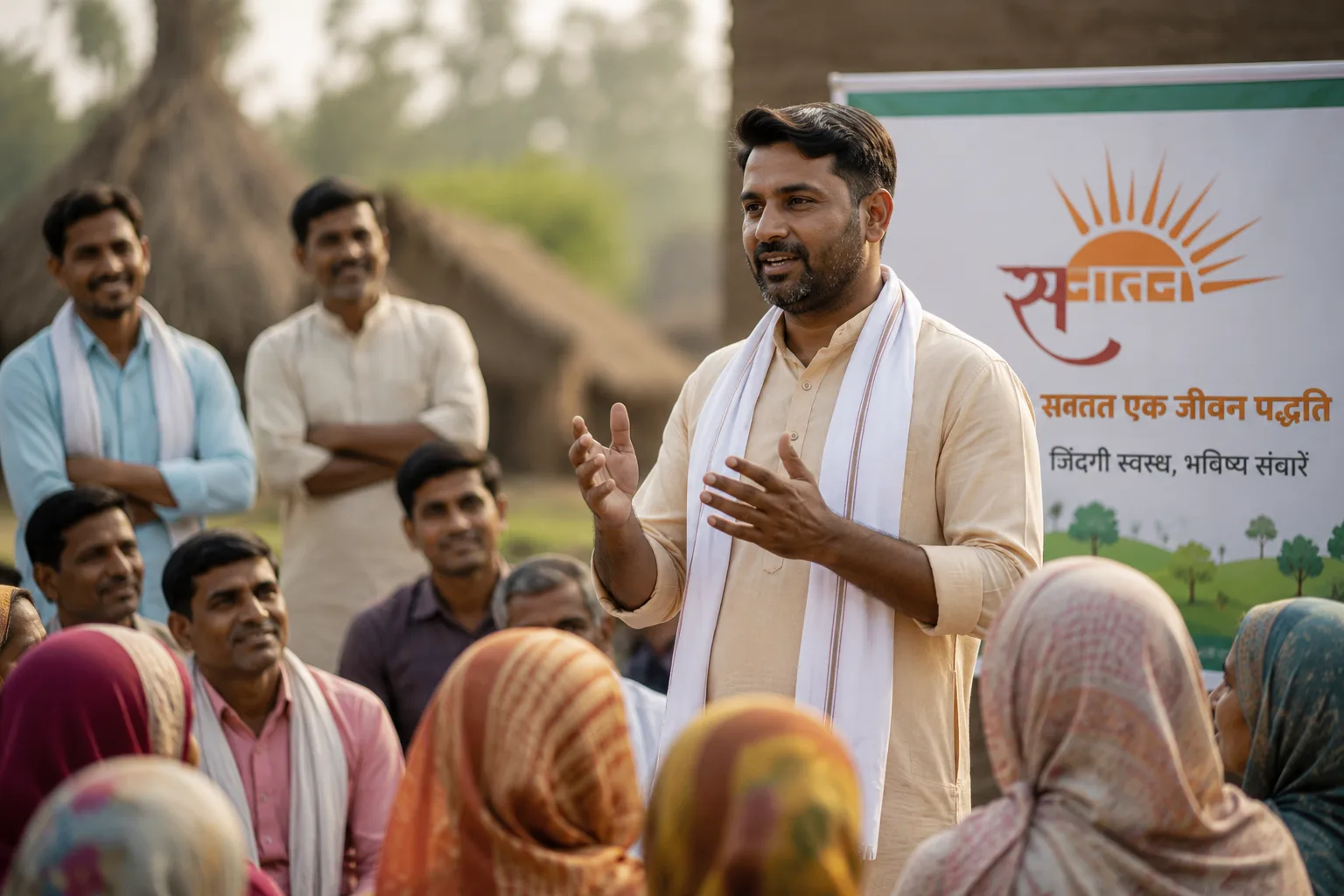
Imagine adopting a village of 500 families. In the first year, conduct a baseline health assessment for every family — collecting data on chronic conditions, nutritional status, common illnesses, and risk factors. Train two or three members of the community as health navigators — people who know the community, are trusted by it, and can identify when someone needs care.
Set up quarterly health camps covering the basic preventive checks. Partner with local pathology labs for testing. Build relationships with district hospitals for referrals when serious conditions are identified.
Track outcomes year over year. Watch hospitalisation rates fall. Watch productivity rise. Watch children's school attendance improve because their eyes can finally see the blackboard.
This is not a fantasy. This is evidence-based preventive healthcare — and it works.
TSF's health programme focuses on preventive, community-based primary care. To learn more or partner with us, visit www.sanaatan.io
